

Table of Contents
- Cat Play Toys Compared: Quick Comparison Table
- Interactive Cat Toys for Indoor Cats: Top Picks
- Best Cat Toys for Independent Play: Solo Enrichment
- How to Play with Your Cat Effectively: Techniques That Work
- Safety and Age-Specific Play Requirements
- DIY Cat Toy Alternatives and Behavioral Science of Play
- Which Cat Play Toys Are Right for Your Feline?
- Conclusion: Building a Playful Routine
- Frequently Asked Questions
Last Updated: October 4, 2026
Cat Play Toys Compared: Quick Comparison Table
At Waggy World, the question we hear most is which cat play toys actually keep an indoor cat busy.
The short answer: cat play toys work best when they match your cat's hunting style, not when they look fun in the photo.
The table below summarises our range at a glance.
| Toy | Price | Play Style | Best For |
|---|---|---|---|
| Feline Fetch Gun | $21.12 | Interactive, you launch | Active cats, bonding |
| Smartpaw Automatic Laser Cat Toy | $48.00 | Automatic, hands-free | Busy owners |
| Interactive Cat Teaser Toy | $19.77 | Interactive wand | Kittens, shy cats |
| Interactive Cat Treat Toy | $19.60 | Puzzle, solo | Food-motivated cats |
| Interactive Electric Mouse Toy | $20.14 | Automatic, motion | Independent play |
| Automatic Rolling Ball | $19.88 | Automatic, rolling | Solo exercise |
Each toy targets a different part of feline enrichment: mental stimulation, physical exercise, or both.

Interactive Cat Toys for Indoor Cats: Top Picks
Interactive cat toys for indoor cats replace the hunting opportunities outdoor cats get naturally. Your cat still has the same prey drive, just nowhere to use it.

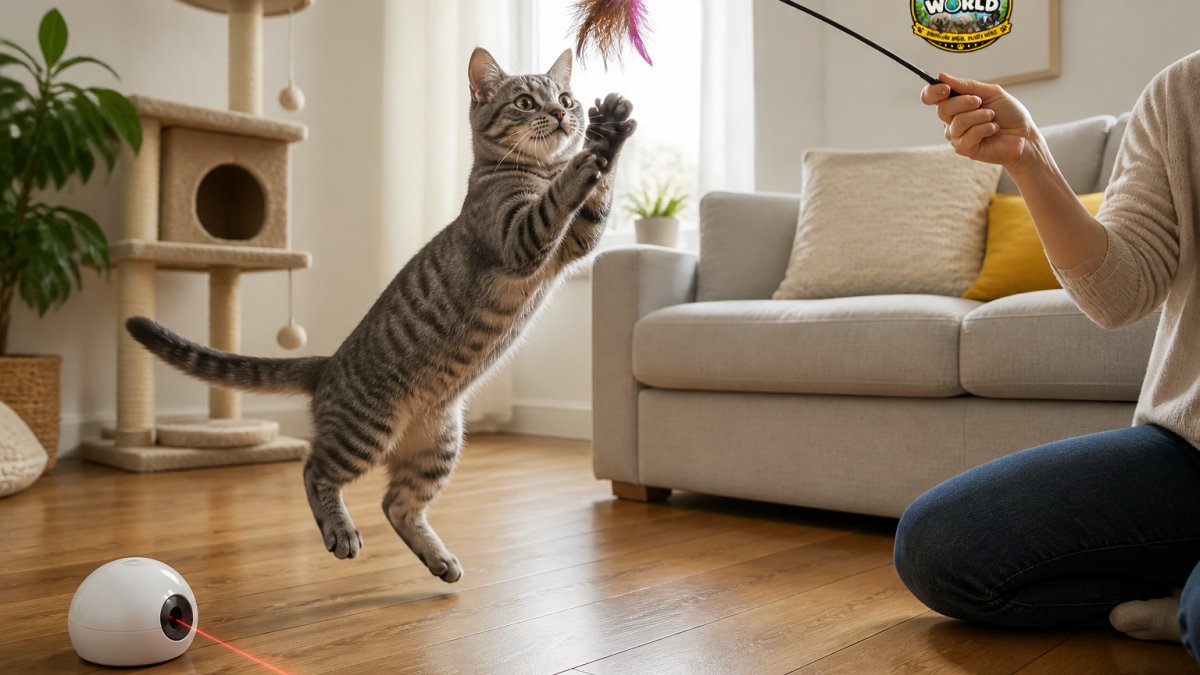
Feline Fetch Gun
The Feline Fetch Gun is our pick for owners who want to be part of the game. You load the soft, lightweight pads, aim, and launch, and your cat chases and pounces.
It suits cats that respond to movement across a room, and the soft pads keep indoor use safe. The downside? It needs you there to operate it, so it is not a solution for long workdays.
Smartpaw Automatic Laser Cat Toy
At $48.00, the Smartpaw is the biggest investment here, and it earns that price through one feature: it runs without you.
A stable base keeps it upright during vigorous play, and you can switch to handheld mode to join in. The honest limitation: some cats learn the light is not catchable, so rotate it with a physical toy.
Interactive Cat Teaser Toy
The Interactive Cat Teaser Toy is the classic feather wand and the single best bonding tool we sell. The flexible rod mimics erratic prey movement, triggering the chase instinct in almost every cat.
It is lightweight, so long sessions do not tire your arm, and shy cats often engage with a wand before they trust anything else in the room.
Best Cat Toys for Independent Play: Solo Enrichment
The best cat toys for independent play keep your cat active while you are at work, asleep, or busy. Boredom prevention matters, because a bored indoor cat redirects that energy into scratching furniture and late-night yowling.
Interactive Cat Treat Toy
This treat-dispensing puzzle hides kibble in compartments and makes your cat work for it. At $19.60, it is the cheapest way to add daily mental stimulation, and it slows down fast eaters. Durable and easy to clean, it suits cats of all ages.
Interactive Electric Mouse Toy
The Interactive Electric Mouse Toy moves in realistic patterns that mimic live prey. At $20.14, it handles solo play well in single-cat and multi-cat households, and its durable build survives vigorous pouncing. Replacement batteries keep it running without long downtime.
Automatic Rolling Ball
The Automatic Rolling Ball rolls unpredictably across the floor, sparking the prey drive with zero input from you. At $19.88, it is a strong entry point for solo enrichment.
It is lightweight and portable, so it works indoors and out. Cats with high energy get the most from it.
How to Play with Your Cat Effectively: Techniques That Work
Knowing how to play with your cat effectively matters more than which toy you buy. A good session copies the rhythm of a real hunt: stalk, chase, pounce, catch, then eat.
Follow this sequence:
- Start slow with the toy near the ground, so your cat can stalk
- Build speed and let your cat chase across the room
- Let your cat catch the toy at least once
- Slow the movement and let them "kill" it
- Finish with a treat or a meal
- Stop while your cat is still interested
Two short sessions a day beat one long one. Ten to fifteen minutes is usually enough for most adult cats.
Safety and Age-Specific Play Requirements
Safety comes down to three things: supervision, toy condition, and matching the toy to your cat's life stage.
Safety checks before every session
Run through this list before you pick up a wand or switch on an automatic toy:
- Inspect wands and feathers for loose strings. Swallowed thread and elastic can cause linear foreign-body blockages, among the more serious intestinal injuries vets see. If a feather hangs by a thread, cut it off.
- Check for small detachable parts. Bells, plastic eyes, and glued-on pom-poms are choking hazards. Anything that fits inside a cardboard toilet-paper tube is small enough for a cat to swallow.
- Avoid ribbon, tinsel, and yarn as solo toys. Fine in a supervised wand session, dangerous when left alone, because cats ingest them while grooming.
Age-specific play requirements
A kitten, an adult, and a senior cat are three different athletes.
Interactive Cat Treat Toy: Keep Your Feline Engaged and Happy →
| Life Stage | Play Focus | Session Length | Best Toy Types | What to Avoid |
|---|---|---|---|---|
| Kitten (0-6 months) | Coordination, bite inhibition, cognitive development | 5-10 min, 3-4 times daily | Small feather wands, soft fabric balls, lightweight rolling toys | Heavy toys, long strings, anything they can chew apart |
| Junior/Adult (6 months-7 years) | Physical exercise, mental stimulation, prey-drive satisfaction | 10-15 min, twice daily | Interactive wands, treat puzzles, motion-sensor mice, fetch toys | Monotonous single-toy routines |
| Mature adult (7-10 years) | Maintaining mobility, weight management | 10 min, once or twice daily | Treat puzzles, slow rolling balls, wand play at floor level | High jumps, fast erratic motion |
| Senior (10+ years) | Gentle movement, low-impact engagement, joint comfort | 5-10 min, once or twice daily | Floor-level rolling balls, food puzzles, soft crinkle toys | Chasing games that require jumping onto furniture |
Kittens need frequent, short bursts because their attention spans are short and their joints are still developing.
Adults have the stamina and coordination for full hunt sequences, so this is the stage to introduce automatic and motion-sensor toys for solo play.
Seniors still benefit enormously from play, but the goal shifts from burning energy to preserving mobility and mental sharpness.
DIY Cat Toy Alternatives and Behavioral Science of Play
Understanding why cats play changes how you choose toys, and it explains why a free cardboard box can outperform a $48 gadget on the wrong day.
The hunt-catch-kill-eat cycle
Feline play is not entertainment. It is a compressed rehearsal of the predatory sequence wild cats run daily: stalk, chase, pounce, catch, kill, eat. Indoor cats still have the full sequence hardwired, but no outlet for it.
This is why the structure of a session matters as much as the toy:
- Stalk, drag the toy slowly along the floor so your cat can crouch and track it.
- Chase, build speed and let them run across the room.
- Pounce, pause the toy briefly so they can launch.
- Catch, let them actually grab it.
- Kill, go still and let them "dispatch" it for a few seconds.
- Eat, finish with a treat or a meal.
That final step is not a gimmick. Pairing the catch with food closes the loop the way a real hunt does, and it is the most reliable way to end a session with a calm cat instead of a wired one.
Why rotation works
Novelty is the active ingredient in any toy. Once a cat has predicted a toy's movement, it stops triggering the chase instinct and becomes furniture, which is why buying one automatic toy and assuming the job is done is the most common mistake.
A practical rotation schedule:
- Keep 3-5 toys in active circulation at a time.
- Swap the active set weekly, storing the rest out of sight (a closed drawer or bin works, cats remember what they can see).
- Keep one wand in permanent rotation, because interactive play is the one category that does not go stale when you control the movement.
DIY cat toy alternatives that actually work
You do not need to buy anything to run a full hunt sequence. These household builds cover the same behavioral ground as store-bought toys:
- Cardboard box + crumpled foil ball. The box is a stalk-and-ambush station; the foil ball is a chase target. Foil is light, unpredictable, and free.
- Paper bag with handles cut off. A crinkle tunnel for stalking. Cut the handles so a cat cannot get a leg caught.
- Toilet-paper tube with treats inside, ends folded. A beginner puzzle feeder. Start with the ends barely folded so the cat wins quickly, then tighten the folds as they get better.
What the behavior science says
The International Cat Care guidance on play and enrichment notes that play builds confidence in shy cats and helps them rehearse social and predatory skills in a safe context.
That is the case for treating cat play toys as enrichment tools rather than entertainment products. The toy is just the delivery mechanism for the hunt.
Which Cat Play Toys Are Right for Your Feline?
Match the toy to your cat's personality and your schedule. That single decision prevents most wasted purchases.
- High-energy cat, home a lot: Feline Fetch Gun and Interactive Cat Teaser Toy
- High-energy cat, out at work: Smartpaw Automatic Laser Cat Toy plus Automatic Rolling Ball
- Food-motivated cat: Interactive Cat Treat Toy
If you are unsure, start with one interactive toy and one solo toy. You will learn quickly which style your cat prefers, and you can build from there.

Conclusion: Building a Playful Routine
The real challenge is not finding cat play toys. It is building a routine your cat can count on when work and life get busy.
That is where Waggy World comes in. We stock a curated range of interactive toys, treat puzzles, and automatic options designed to keep indoor cats active and happy.
Get started with Waggy World and build a play routine your cat looks forward to.
Frequently Asked Questions
What are the best types of cat play toys for indoor cats?
For indoor cats, the best cat play toys include interactive wands, automatic laser toys, treat-dispensing puzzles, and motion-sensor balls. These toys mimic prey and encourage natural hunting instincts. The Feline Fetch Gun and Smartpaw Automatic Laser Cat Toy are excellent for active play, while the Interactive Cat Treat Toy provides mental stimulation. Rotate toys weekly to prevent boredom.
How often should I rotate my cat's play toys?
Rotate your cat's play toys every 3-5 days to maintain novelty and engagement. Cats get bored with the same toys, so swapping them out keeps play exciting. Keep 3-4 toys available at a time and store the rest. This simple habit can reduce destructive behavior and provide ongoing mental stimulation.
Are interactive cat toys worth the investment?
Yes, interactive cat toys are worth it because they provide physical exercise and mental stimulation, reducing boredom and destructive behavior. Automatic toys like the Smartpaw Laser Toy or Electric Mouse Toy keep cats active even when you're busy. They also strengthen your bond during supervised play. Prices range from $14.77 to $48.00, making them affordable for most budgets.
What are the safest cat play toys for kittens?
For kittens, choose soft, lightweight toys without small parts that can be swallowed. The Interactive Cat Teaser Toy with feathers is ideal for supervised play, and the S-Shaped Cat Tunnel offers safe exploration. Avoid toys with strings or batteries unless supervised. Always check for loose pieces and replace worn toys promptly.
How can I keep my cat entertained when I'm not home?
Use automatic toys like the Smartpaw Automatic Laser Cat Toy or the Automatic Rolling Ball to keep your cat engaged while you're away. Puzzle feeders such as the Interactive Cat Treat Toy also provide solo entertainment by dispensing treats as your cat plays. Set them on a timer or motion sensor to mimic prey and prevent boredom.